
Warren County Court Records After a Jail Arrest
After an arrest in Warren County, the first record is usually a jail or agency record. The Warren County Sheriff's Office books the person or receives the commitment, and Georgia law requires the sheriff to keep a record of people committed to the county jail under O.C.G.A. 42-4-7. That commitment record is not the same thing as the court record. The court file begins to matter once the arrest is routed through first appearance, bond, warrant review, prosecutor screening, and formal charging.
Warren County is in the Toombs Judicial Circuit. The District Attorney is Bill Doupe, and the DA decides what charges to pursue after reviewing the arrest, evidence, warrant material, and law-enforcement reports. Formal charges may proceed by accusation, information, or indictment depending on the offense and procedure. Once a criminal case exists, the Warren County Clerk of Courts maintains the criminal case records, including filed charges, case numbers, trial calendars, subpoenas, court notices, jury matters, fees, fines, and proceedings.
Use jail inmate records for the custody side of the event, such as whether the person is currently held at the Warren County Jail, whether bond has been set, or whether a hold exists. Use jail mugshots for booking-photo rules and request limits. Court records after a jail arrest answer a different question: what case was filed, which charges were accepted or changed by the prosecutor, what hearing or bond action occurred, and whether the case is still pending, dismissed, resolved by plea, or set for further proceedings.
Where Warren County Arrest Cases Go in Court
Warren County's local pathway starts at booking and usually moves quickly to Probate and Magistrate Court functions. The official Probate and Magistrate Court page lists criminal warrants, search warrants, pre-warrants, first appearance bond hearings, preliminary hearings, and extradition hearings. Judge Jeremy Rachels serves that court at 521 Main Street, Suite 104, Warrenton, GA 30828. Published phone numbers are 706-465-2227 and 706-465-3123.
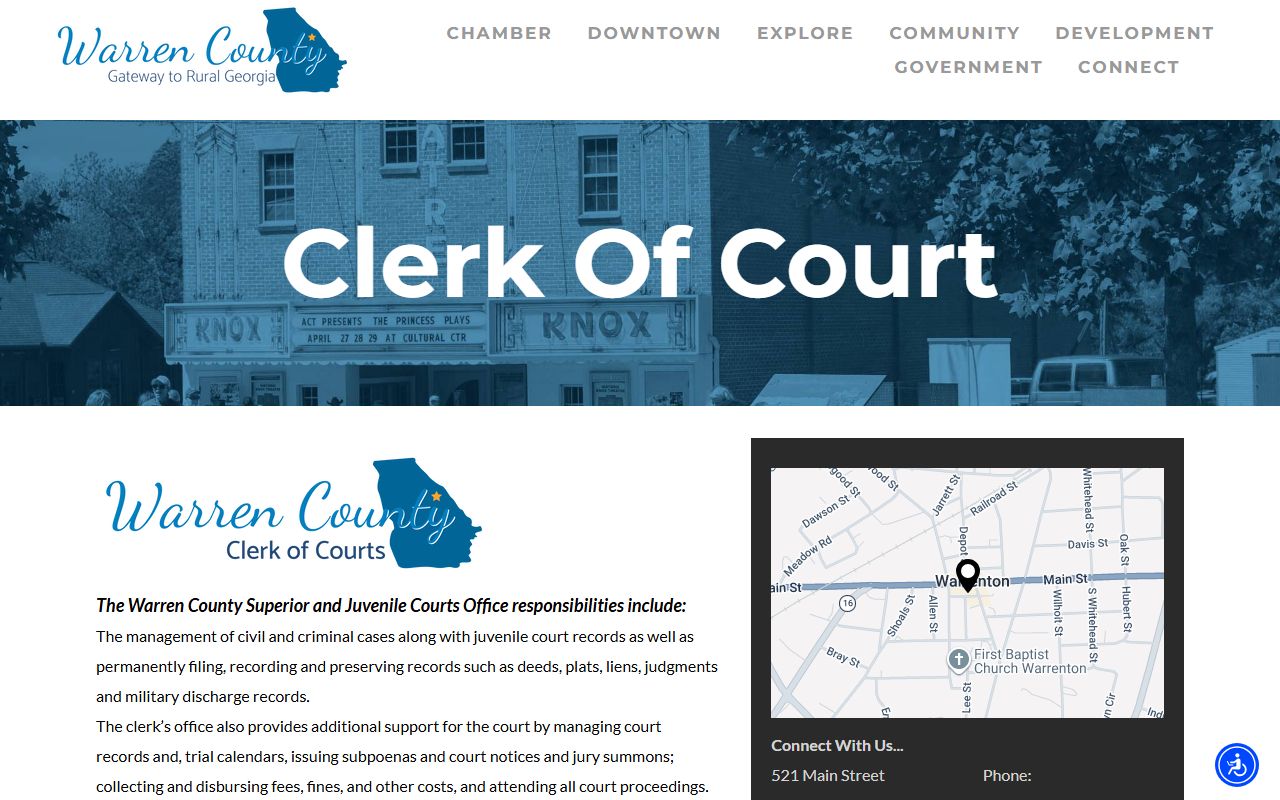
The Clerk of Courts is the central contact for criminal case-file records once a case has been opened or filed. The Clerk is Cynthia Cheely-Lazenby, located at 521 Main Street, Warrenton, GA 30828, phone 706-465-2262. The Superior Court page lists Chief Judge Harold Hinesley, Judge Thomas B. Hammond, Juvenile Judge James T. Jones, and District Attorney Bill Doupe. For prosecution questions that properly belong with the DA, the Toombs Judicial Circuit District Attorney's Office is at P.O. Box 966, 210 Railroad St., Thomson, GA 30824, phone 706-595-7175, and the circuit includes Warren County.
The Warren County Clerk page describes the criminal and civil case-management role that makes the Clerk the practical records contact after the DA files or presents charges. The official Clerk of Courts page is especially relevant because it identifies the office that maintains the court proceedings after an arrest leaves the booking stage.
How to Find Warren County Court Records After an Arrest
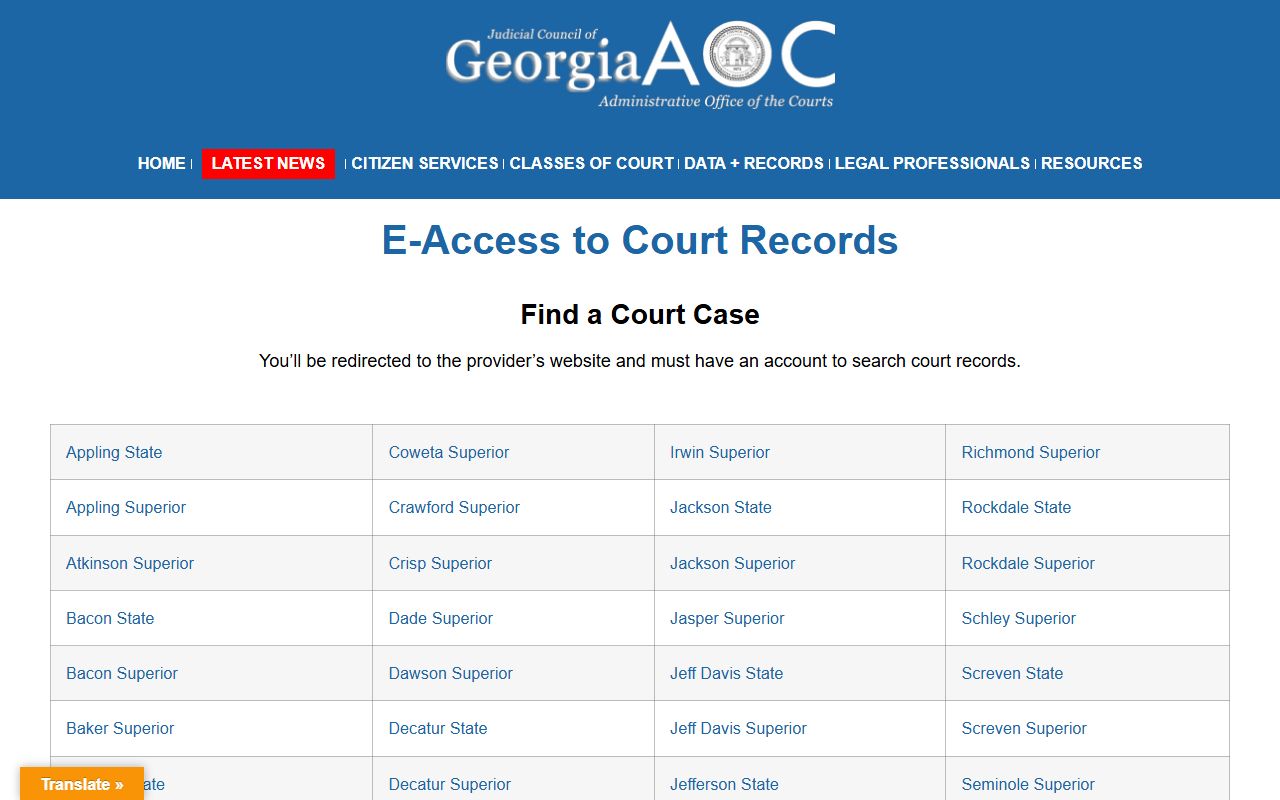
Warren County does not provide a single official online warrant search, active jail roster, or complete county criminal-case portal on the sheriff's site. The official search path is therefore a chain: confirm the booking or warrant custody with the Sheriff's Office, ask the Clerk of Courts whether a criminal case number exists, then check the Georgia Courts eAccess directory for Warren Superior provider routing. Georgia Courts eAccess lists Warren Superior, but the state directory redirects users to provider sites, and an account may be required before search fields or documents are visible.
- Start with the Warren County Sheriff's Office if the arrest is recent. Call 706-465-3340 and ask whether the person is in custody, whether bond has been set, and whether a hold or warrant source affects release.
- Contact the Warren County Clerk of Courts at 706-465-2262 for criminal case-file status, filed charges, docket number, hearing dates, and record-access routing.
- Use the Georgia Courts eAccess directory to see Warren Superior provider access, understanding that the state page may route to PeachCourt, re:SearchGA, or another provider instead of a free county search screen.
- Check each charge separately. The booking charge, warrant language, accusation, indictment count, amendment, dismissal, and sentence entry may not all use the same words.
- For victim, witness, or prosecution-status routing, contact the Toombs Judicial Circuit District Attorney's Office at 706-595-7175 when the question belongs with the prosecutor rather than the Clerk.
The official Georgia Courts eAccess page explains the provider model, and the vendor page lists PeachCourt and re:SearchGA/Tyler among available provider routes. The Warren County Clerk also links the Georgia Superior Court Clerks' Cooperative Authority, which is a statewide clerk resource, though criminal case access still depends on the Clerk's office and provider availability.
Court eAccess Search Fields and Provider Limits
The most important eAccess detail for Warren County is not a field label, but the access model. The state eAccess directory lists Warren Superior, then directs users to provider websites. Because provider login may be required, the public directory does not expose a full Warren County search form with guaranteed name, case number, date, or charge fields before a user reaches the provider environment.
| Access Point | Search or Provider Detail | Warren County Use |
|---|---|---|
| Georgia Courts eAccess directory | Directory and routing page, not a single statewide case-search form | Lists Warren Superior and sends users toward provider access |
| Provider selection | PeachCourt and re:SearchGA/Tyler appear on the Georgia Courts vendor page | Provider account or login may be needed before searching |
| Case number | May be available inside a provider or through the Clerk | Ask the Clerk of Courts if a docket number has been assigned |
| Defendant name | Common case-search route, but not confirmed from the public directory screen | Use full legal name and date context when asking the Clerk |
| Charge or offense | Usually read from the filed case after locating it | Compare booking labels with accusation, information, or indictment counts |
How Charges Get Filed After an Arrest: Complaint, Accusation, Information, and Indictment
A jail booking can list a charge quickly, but that label is preliminary. The prosecutor reviews the arrest and evidence before deciding what formal criminal charges to pursue. In Warren County, that review is handled through the Toombs Judicial Circuit District Attorney for cases within the DA's authority. Formal charges may differ from what appeared at booking because the DA may add counts, reduce a count, amend a count, dismiss a count, or present a felony matter for indictment.
| Document | Who Uses or Files It | How It Fits After a Jail Arrest |
|---|---|---|
| Complaint | Law enforcement or court process | Often describes the alleged offense at the earliest stage and may support warrant or first appearance routing. |
| Accusation | Prosecutor | A formal charging document used by the prosecutor for eligible criminal cases without a grand jury indictment. |
| Information | Prosecutor | A prosecutor-filed charging document, used when permitted by procedure and case posture. |
| Indictment | Grand jury | A grand jury charging document, commonly associated with felony prosecution and Superior Court handling. |
When researching court records after a jail arrest, treat each document as part of a timeline. A warrant or booking label may explain why someone was taken into custody. The accusation, information, or indictment explains what the state formally chose to prosecute. Later docket entries show whether those counts remained pending, were amended, were dismissed, or ended in a plea, trial verdict, or sentencing order.
Charge Status and What It Means in Warren County Court Records
Charge status can change as an arrest moves through court. A jail record may show the offense listed at booking, while the court record shows the filed count and later status. That difference is normal and does not mean either office made a mistake. It means jail custody records and court prosecution records answer different questions.
| Status | What It Means | Where to Verify |
|---|---|---|
| Pending | The charge remains open and has not reached final disposition. | Clerk of Courts docket or provider case record |
| Amended | The charge language, count, code, or factual allegation changed after filing. | Filed accusation, indictment, order, or docket entry |
| Reduced | The prosecutor or court process moved the case to a lesser offense or lower charge level. | Disposition entry, plea paperwork, or sentencing record |
| Dismissed | The count is no longer being prosecuted in that case. | Dismissal order or docket disposition |
| Nolle prosequi | The prosecutor declined to continue that charge, often shown as a formal disposition entry. | Clerk case file or DA-related docket entry |
| Convicted | The charge resulted in guilt by plea or verdict. | Sentence sheet, disposition, or judgment record |
Bond and Release After an Arrest
Warren County Probate and Magistrate Court lists first appearance bond hearings as a local function. Georgia bond law, O.C.G.A. 17-6-1, governs bailable offenses, bond procedure, and secured-bond issues. The county does not publish a local bond schedule, jail bond desk hours, acceptable payment methods, or bonding-company list, so the practical step is to call the Sheriff's Office at 706-465-3340 before going to the jail or sending anyone to post bond.
| Bond Type | How It Works |
|---|---|
| Cash bond | Money is posted directly to secure release and the person's later court appearance. |
| Surety bond | A bonding company or surety posts the bond; fees paid to a bondsman are usually not refunded. |
| Property bond | Property may be pledged if accepted and approved under Georgia and local rules. |
| Personal recognizance or unsecured release | The person is released on promise, conditions, or unsecured terms when authorized. |
| No-bond hold | Release is blocked until a judge or holding agency clears the matter. |
A person may remain in jail even after a bond amount appears if there is a hold from another court, another county, probation or parole, federal authorities, immigration, or a separate warrant. If formal charges are already in Superior Court, the Clerk of Courts can help identify the case-record routing, while the Sheriff's Office remains the source for current custody and release mechanics.
Warrants That Lead to an Arrest and Court Records
No official Warren County active warrant search, most-wanted page, or public warrant list was located on the county or sheriff website. The best official local source is the Probate and Magistrate Court page, which lists criminal warrants, search warrants, pre-warrants, peace warrants, first appearance bond hearings, preliminary hearings, and extradition hearings among its functions. For a served warrant and current custody, call the Sheriff's Office at 706-465-3340. For warrant-related court functions, call Probate and Magistrate Court at 706-465-2227 or 706-465-3123.
A warrant becomes part of the court-records-after-arrest trail when it is served and the person is booked. The jail commitment record should reflect the process under which the person was committed and the issuing source. Later, the court file may show the warrant source, bond action, preliminary hearing information, formal charges, or a bench warrant if the person failed to appear after release.
Charges vs. Convictions After a Warren County Arrest
An arrest and charge are not the same as a conviction. A charge is an accusation being reviewed or prosecuted. A conviction is a final result based on a guilty plea, verdict, or other adjudication that results in guilt. Warren County court records may show both preliminary charges and final outcomes, so the disposition matters as much as the charge label.
| Charge | Conviction | |
|---|---|---|
| Case stage | Allegation filed or pursued after an arrest | Final guilt result by plea or verdict |
| Proof level | May begin from probable cause or prosecutor filing decision | Requires proof beyond a reasonable doubt or a valid guilty plea |
| Record meaning | Shows what the person was accused of in court | Shows the criminal case ended in guilt on that count |
| Can change | May be amended, reduced, added, dismissed, or not prosecuted | May affect sentence, criminal history, and later restriction eligibility |
Sealed vs. Expunged or Restricted Court Records
Georgia commonly uses the language of record restriction rather than the everyday phrase expungement. O.C.G.A. 35-3-37 governs inspection, correction, and restriction of criminal history record information. First offender public-access limits are addressed in O.C.G.A. 42-8-62.1, and juvenile file sealing is addressed in O.C.G.A. 15-11-701. Eligibility depends on the charge, disposition, timing, and court order or statutory pathway.
| Sealed | Expunged or Restricted | |
|---|---|---|
| Public visibility | Hidden from ordinary public access by court order or statute | Restricted from public criminal-history access when Georgia law allows |
| Record existence | The file generally still exists but is not open to normal public viewing | The Georgia process usually limits access rather than physically destroying every record |
| Common examples | Juvenile files, sealed court matters, certain protected proceedings | Eligible dismissed, non-prosecuted, corrected, or first-offender-related records |
| Where to ask | Clerk of Courts or the court that sealed the case | Clerk, prosecutor, arresting agency, or criminal-history process depending on the record |
Open Records Limits on Court and Arrest Records
Georgia's Open Records Act starts with a broad access rule. O.C.G.A. 50-18-70 states the open-government policy, and O.C.G.A. 50-18-71 addresses inspection, copying, timing, and costs. But court and law-enforcement records are not all open in the same way. O.C.G.A. 50-18-72 lists exemptions, including law-enforcement or prosecution material where release would reveal protected investigative information, endanger people, or expose data that the law protects.
For Warren County, that means a request should be directed to the correct custodian. The Sheriff's Office is the starting point for jail commitment, discharge, booking, custody, and warrant-service records. The Probate and Magistrate Court is the local contact for warrant functions, first appearance bond hearings, preliminary hearings, and extradition hearings. The Clerk of Courts is the contact for filed criminal case records. The District Attorney handles prosecution decisions and victim or witness process questions, but the DA is not a substitute for the Clerk's case-file function.
Background Check Considerations
Court records after a Warren County jail arrest can be useful for personal research, case tracking, or verifying the source of a charge. They should not be treated as a consumer background report. A casual court lookup may be incomplete, may omit restricted records, may show an old pending status that later changed, or may require confirmation from the Clerk of Courts or the originating agency. Anyone making a decision covered by the Fair Credit Reporting Act needs a lawful FCRA-compliant process, not a general public-record search.
Important: This privately operated site is not a consumer reporting agency and cannot be used for FCRA-covered decisions.
Restricted Court Records After an Arrest in Warren County
Some Warren County court records after an arrest may be unavailable, partly visible, redacted, or handled outside ordinary public access. Juvenile matters are treated differently from adult criminal cases, and juvenile file sealing is governed by O.C.G.A. 15-11-701. First offender matters can have public-access limits under O.C.G.A. 42-8-62.1. Criminal history correction and restriction issues run through O.C.G.A. 35-3-37. Open investigations, protected witness information, victim data, sealed orders, and exempt prosecution records may also be withheld or redacted under Georgia's Open Records Act exemptions.
When a search result is missing, do not assume the arrest never happened or that a case was never filed. The record may be too new for a provider, held by a different custodian, restricted by statute, routed through a different court, or listed under a different case number. The most reliable sequence is to verify custody with the Sheriff's Office, ask Probate and Magistrate Court about first appearance or warrant functions when relevant, and ask the Clerk of Courts whether a criminal case record exists.